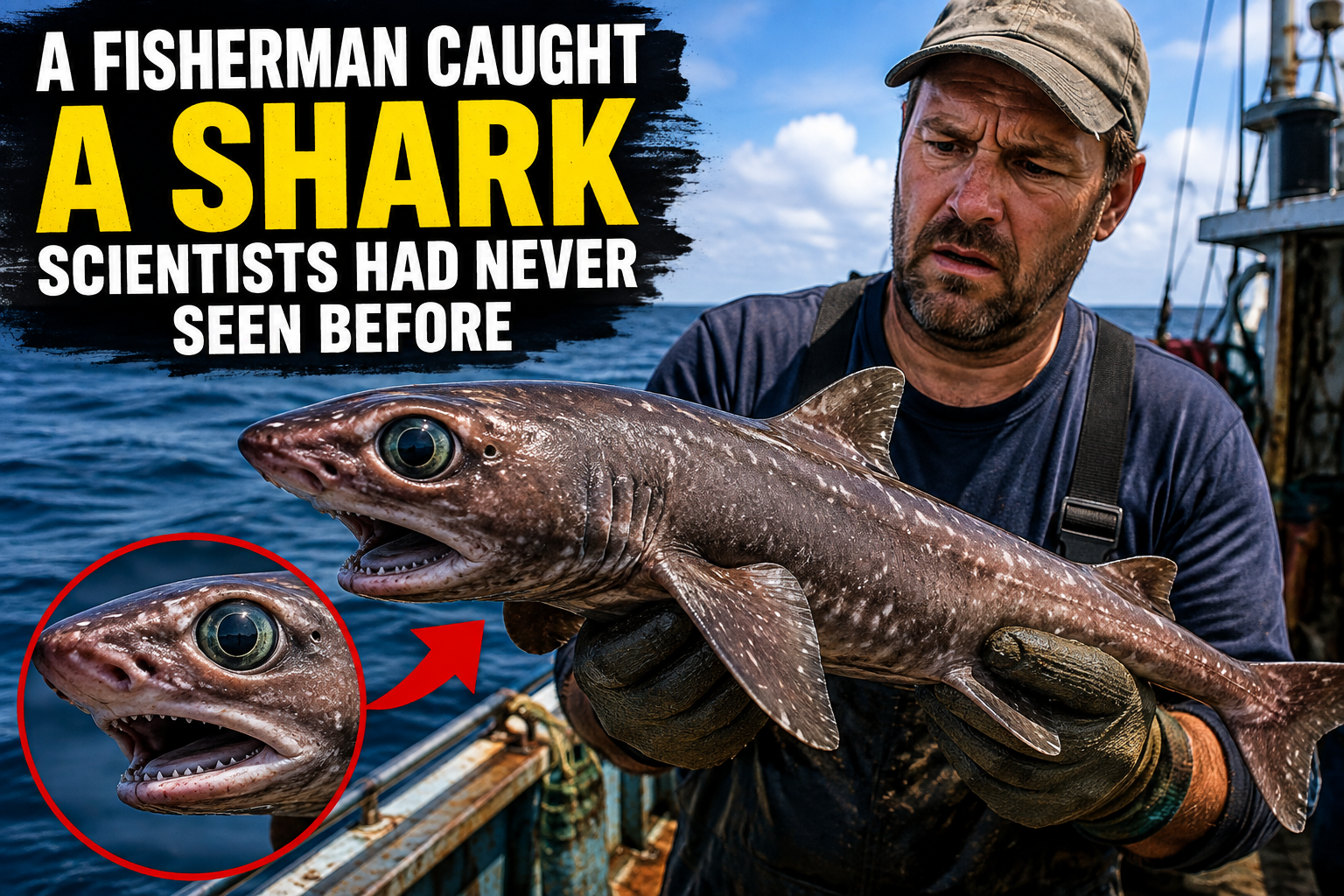
For years, fishermen in Sri Lanka had been catching a small, unusual shark from the deep waters of the Indian Ocean.
They did not consider it a major discovery.
In fact, they reportedly caught several of them and simply threw them back into the sea.
Then one day, a shark scientist came looking for the mysterious animal.
What happened next turned an ordinary fishing catch into a scientific discovery.
The shark turned out to be a species that had not previously been recognized by science.
Today, it is known as the Eastern Dwarf False Catshark, or Planonasus indicus.
The story is a remarkable reminder that new species are not always discovered during expensive scientific expeditions. Sometimes, they are already being caught by local fishermen — and nobody realizes how unusual they are.
The Mysterious Shark
The story began when shark researcher David Ebert saw photographs of an unusual-looking shark.
He could not immediately determine exactly what species it was.
That uncertainty made him curious.
During research work in Sri Lanka, Ebert and his colleagues visited the area around Muttur in Trincomalee Harbour.
Instead of relying only on scientific surveys, Ebert decided to speak directly with local fishermen.
He showed them a photograph of the strange shark and asked whether they had ever seen anything like it.
The fishermen’s response was unexpected.
They knew the shark.
In fact, they told him to come back the next day.
When Ebert returned, the fishermen had one of the mysterious sharks available.
According to Ebert’s account, the fishermen explained that they caught these sharks regularly. One fisherman reportedly said they had caught three the previous day and normally threw them back.
The fishermen had no idea that the animal they considered an ordinary catch might represent something completely new to science.
A New Species Hidden in Plain Sight
For Ebert, the encounter was a major clue.
The shark looked similar to another species known as the Dwarf False Catshark, Planonasus parini.
At first, researchers considered the possibility that the Sri Lankan specimens might simply belong to that already-known species.
But detailed examination revealed important differences.
Scientists compared the sharks’ physical characteristics, including their teeth, fins, body proportions and other anatomical features.
The differences were significant enough to show that the Sri Lankan and Indian specimens represented a distinct species.
The new shark was formally described as Planonasus indicus.
Its common name is the Eastern Dwarf False Catshark.
The species belongs to the false catshark family, Pseudotriakidae.
It Wasn’t a Giant Shark
Despite the dramatic discovery, this was not a massive predator like a great white or tiger shark.
The Eastern Dwarf False Catshark is actually quite small.
FishBase lists its maximum recorded size at about 64 centimetres. It is a deep-water shark found in the Indian Ocean, including waters around India and Sri Lanka. Records place it at depths of roughly 200 to 1,000 metres.
That deep-water lifestyle may help explain why scientists knew so little about it.
People rarely encounter animals living hundreds of metres below the ocean surface.
Even though fishermen operating in deep waters may occasionally bring them up as bycatch, the animals can easily go unnoticed by scientists.
In this case, local knowledge became the missing link.
The Shark Had Been Caught Before Scientists Recognized It
One of the most fascinating parts of the story is that the shark was not necessarily rare in the sense of never being caught.
The fishermen already knew about it.
They had seen it.
They had caught it.
And they had even caught multiple specimens.
What was missing was scientific recognition.
This distinction is important.
A species can exist in an ecosystem for thousands or millions of years without being formally recognized by scientists.
Scientific discovery does not necessarily mean that an animal has suddenly appeared.
Sometimes it means scientists have finally realized that an animal already living in the world is different from every species previously described.
That is exactly what happened with Planonasus indicus.
How Scientists Knew It Was Different
Identifying a new shark species requires much more than simply saying that an animal looks unusual.
Scientists need measurable evidence.
Researchers compared the Eastern Dwarf False Catshark with its closest relative and found a number of anatomical differences.
Among the characteristics used to distinguish Planonasus indicus are differences in its mouth structures, teeth, fins, body proportions and other physical features.
For example, FishBase notes differences in the number of tooth rows in the lower jaw and several proportional measurements of the body and fins.
These details may seem small to someone looking at a photograph.
To a shark taxonomist, however, they can be extremely important.
A few anatomical differences can reveal that two animals that look similar actually belong to separate species.
Where Does This Shark Live?
The Eastern Dwarf False Catshark is a deep-water marine species.
It has been recorded from the Indian Ocean, particularly around India and Sri Lanka.
Its known depth range extends from approximately 200 metres down to 1,000 metres.
At those depths, sunlight becomes extremely limited and the environment is very different from the coastal waters humans normally associate with sharks.
The shark is classified as bathydemersal, meaning it lives close to the seafloor in deep marine environments.
Scientists still know relatively little about its biology.
That makes every specimen valuable.
Researchers have much more to learn about its population, reproduction, diet and behavior.
A Discovery That Shows Why Fishermen Matter
The discovery also highlights something scientists increasingly recognize: local fishermen can possess valuable knowledge about marine life.
Fishermen spend enormous amounts of time on the water.
They can encounter species that researchers may rarely see during organized surveys.
In this case, the fishermen were already familiar with the shark before scientists had formally recognized it.
Without Ebert asking them about the animal, the species might have remained poorly understood for even longer.
The story is therefore not simply about a scientist discovering a new shark.
It is also about a scientist listening to people who regularly work in the environment where the animal lives.
What Makes the Discovery So Interesting?
The Eastern Dwarf False Catshark is not famous for its size.
It is not known for attacking humans.
It does not have the dramatic reputation of a great white shark.
Instead, its story is interesting because of how easily a new species can remain hidden.
Imagine catching the same unusual-looking shark several times and assuming it is simply another deep-sea fish.
Now imagine a scientist examining that same animal and realizing that it represents a species previously unknown to science.
That is what makes the discovery remarkable.
The ocean is enormous, and much of it remains difficult for humans to explore.
Scientists continue to discover new marine species, particularly in deep-water environments.
There May Be More Unknown Sharks
Perhaps the most surprising part of Ebert’s story is that the Eastern Dwarf False Catshark may not be the only unknown shark waiting to be formally recognized.
In his interview with San José State University, Ebert said he had another 20 to 30 sharks in his laboratory that he was researching and that some could potentially represent new species.
That means the story of the fisherman and the mysterious shark may be part of a much larger scientific puzzle.
There could be other unusual sharks living deep beneath the ocean that scientists have not yet properly identified.
Some may occasionally appear as bycatch.
Others may never come close enough to the surface to be encountered.
And some could remain unknown for decades.
The Shark That Changed What Scientists Knew
The Eastern Dwarf False Catshark eventually received its scientific identity: Planonasus indicus.
Its discovery demonstrates that finding a new species does not always require discovering an animal in a completely unexplored location.
Sometimes the animal has been there all along.
Sometimes fishermen have already seen it.
Sometimes specimens have already been caught.
The real breakthrough comes when someone stops and asks a simple question:
“What exactly is this?”
In the case of this small deep-sea shark, that question led scientists from a photograph to a fishing harbour, from a fisherman to a specimen, and eventually from an unusual catch to a formally recognized species.
More than anything, the story shows just how much remains unknown beneath the world’s oceans.
A shark that fishermen had been catching and releasing turned out to be an animal science had not yet formally recognized.
And somewhere in the deep ocean, there may still be many more waiting to be found.