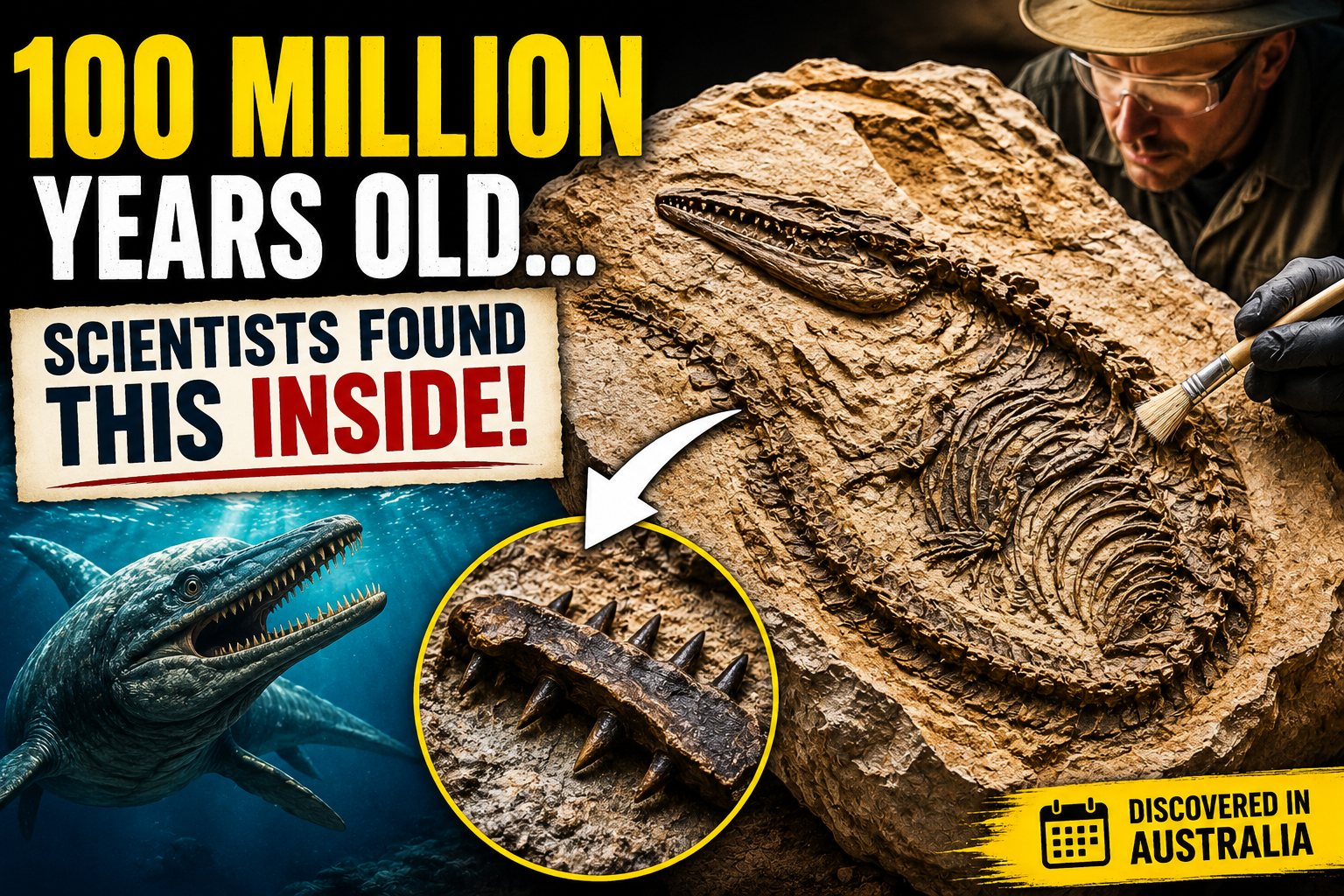
For more than 100 million years, the remains of a prehistoric predator lay buried beneath what is now the Australian Outback.
When fossil hunters first came across the bones in Queensland, they had no idea they were looking at the remains of an extraordinary prehistoric event. The fossil appeared badly broken and scattered, almost like a random collection of bones.
But researchers eventually discovered that the fossil contained something much more unusual.
Inside the body of the ancient marine reptile were the remains of another animal — including part of a pterosaur, a flying reptile that lived alongside the dinosaurs.
And that was only the beginning.
The same fossil also carried evidence suggesting that the animal containing the pterosaur remains had itself been attacked by one of the most powerful predators of Australia’s ancient seas: Kronosaurus queenslandicus.
The result is an extraordinary prehistoric food chain preserved in stone:
Pterosaur → Ichthyosaur → Kronosaurus
Scientists say the discovery provides some of the clearest evidence ever found of a three-level predator interaction in the fossil record.
A Strange Discovery in the Australian Outback
The story began in 2019 near Richmond in north-west Queensland.
The region looks very different today from how it would have looked 100 million years ago. During the Early Cretaceous, much of central Australia was covered by the enormous Eromanga Sea.
Instead of dry landscapes and remote outback terrain, prehistoric marine reptiles moved through these ancient waters.
In 2019, fossil hunters Mick and Cathy Freeman, along with Gary and Barb Flewelling, discovered a collection of large bones at a public fossil site near Richmond.
The remains were eventually nicknamed B.O.B., short for “Bag of Bones.”
At first, nobody knew just how important the discovery would become.
Several years later, researchers and museum staff returned to the site and began excavating more of the fossil. The preparation and reconstruction required hundreds of hours of careful work.
What initially looked like a damaged collection of bones slowly began to reveal the skeleton of a large ichthyosaur.
The animal, identified as Platypterygius australis, was approximately 6 to 7 metres long.
Ichthyosaurs were marine reptiles, not dinosaurs. They evolved bodies that looked somewhat like modern dolphins, although they were completely unrelated to dolphins and other mammals. They lived in Earth’s oceans for millions of years while dinosaurs dominated the land.
The Fossil Was Hiding Something Inside
The biggest surprise came when scientists examined the fossil more closely.
The ichthyosaur’s skeleton was incomplete and heavily damaged, but some material from its body cavity had survived.
Researchers used advanced imaging techniques, including neutron tomography, to investigate the fossil without destroying it.
The scans revealed fragments of fish, cephalopods and, most remarkably, part of a pterosaur jaw inside the ichthyosaur’s body.
This was extremely important.
Pterosaurs were flying reptiles that lived during the age of dinosaurs. They were not dinosaurs themselves, but they were close evolutionary relatives within the broader reptile group.
Scientists had previously found evidence of ichthyosaurs eating fish and squid-like animals. But this fossil provided the first definitive evidence that an ichthyosaur had consumed a pterosaur.
That means the animal in the fossil had eaten a creature that lived primarily in the air.
Exactly how it happened is still uncertain.
The pterosaur may have been floating on the water, struggling after landing, or possibly been caught by the ichthyosaur while close to the sea surface.
Scientists cannot reconstruct the exact moment from the fossil alone.
But the remains inside the ichthyosaur provide something much more valuable than speculation: physical evidence of what the animal had eaten.
The “Last Meal” Was Only Half the Story
If the discovery had ended there, it would already have been remarkable.
But researchers noticed something else.
The ichthyosaur’s skeleton showed extensive damage.
Its bones were shattered in places, some ribs were missing, and numerous large crushing and bite marks were visible across the remains.
These injuries were not consistent with an ordinary, undisturbed death.
They suggested that another large predator had attacked or scavenged the ichthyosaur.
And scientists had a strong candidate.
Kronosaurus queenslandicus.
Meet Kronosaurus — The Giant Predator of the Eromanga Sea
Kronosaurus was a giant marine reptile belonging to a group called pliosaurs.
It was not a dinosaur.
But if you were swimming in the Eromanga Sea around 100 million years ago, that distinction probably would not have made you feel any safer.
Kronosaurus was an apex predator with a powerful skull and large teeth designed for grabbing and tearing prey.
Researchers believe that an adult Kronosaurus could reach roughly 10–12 metres or more, depending on the estimate and specimen.
It was one of the dominant predators of Australia’s ancient inland sea.
The bite marks and crushing injuries on the ichthyosaur are consistent with an attack or scavenging event involving a large predator such as Kronosaurus queenslandicus.
However, scientists are careful about one important detail.
They cannot say with absolute certainty that the Kronosaurus killed the ichthyosaur.
It is possible that the ichthyosaur was already dead when the Kronosaurus began feeding on it.
The fossil evidence tells scientists what happened to the bones, but it cannot provide a perfect recording of the exact sequence of events.
That uncertainty is part of what makes the discovery scientifically interesting.
A Three-Level Prehistoric Food Chain
Put the evidence together and scientists can reconstruct an extraordinary sequence.
First, a pterosaur became part of the ichthyosaur’s diet.
The ichthyosaur then died, either because it was attacked by a larger predator or from another cause.
Afterward, a giant Kronosaurus appears to have attacked or scavenged the ichthyosaur.
The fossil therefore preserves evidence of three animals connected through feeding:
Pterosaur → Platypterygius → Kronosaurus
That is extremely rare in the fossil record.
Usually, scientists find evidence of a single predator-prey relationship — one animal’s teeth marks on another animal’s bones, for example.
Finding evidence that connects three different levels of a food chain in the same fossil discovery is much more unusual.
Researchers described the discovery as one of the clearest examples of a three-tier predator interaction ever found.
It gives scientists a rare glimpse into an ecosystem rather than simply revealing what one prehistoric animal looked like.
Why Preserving a Last Meal Is So Rare
Finding fossilized stomach contents is extraordinarily difficult.
After an animal dies, its soft tissues normally decay. Scavengers can scatter bones, currents can move remains, and geological processes can destroy or bury evidence.
For an animal’s last meal to remain recognizable inside its body, a very specific chain of events has to occur.
Researchers believe rapid burial played an important role in preserving the B.O.B. fossil.
The ichthyosaur may have died in the water column and then sunk toward the seabed. If it was buried quickly enough, the remains inside its body could remain relatively close to their original position.
That created a kind of natural time capsule.
More than 100 million years later, scientists were able to examine that ancient meal using modern technology.
Without advanced imaging, some of the material hidden inside the fossil might have remained impossible to identify without damaging the specimen.
Scientists Still Don’t Know Exactly What Happened
The fossil provides powerful evidence, but it does not answer every question.
For example, did the ichthyosaur actively catch the pterosaur?
Was the flying reptile already dead?
Did the Kronosaurus kill the ichthyosaur?
Or did it discover and feed on the carcass after the ichthyosaur had already died?
These questions may never be answered with complete certainty.
One possibility is that the ichthyosaur encountered a pterosaur at the surface and swallowed it.
Another is that the pterosaur had fallen into the water or was floating there when the ichthyosaur found it.
Then, sometime afterward, the ichthyosaur may have encountered the much larger Kronosaurus.
The fossil does not preserve a video of the event. Instead, scientists are reconstructing the story from bones, bite marks, stomach contents and geological evidence.
That is exactly what makes palaeontology fascinating: researchers are effectively investigating a crime scene that is more than 100 million years old.
A Window Into Australia’s Ancient Ocean
The discovery is important for another reason.
Modern Australia contains enormous areas of dry land, but its geological history is filled with evidence of ancient seas.
The Eromanga Sea once covered a large part of what is now inland Australia.
During the Cretaceous period, marine reptiles, fish, cephalopods and flying reptiles interacted in this enormous aquatic environment.
The B.O.B. fossil provides a snapshot of those interactions.
Instead of simply showing that a particular species existed, it shows how different animals may have interacted within the same ecosystem.
It tells scientists something about feeding behaviour, predator-prey relationships and the movement of energy through an ancient food web.
In other words, the fossil is not just a skeleton.
It is evidence of an entire ecosystem frozen in geological time.
The Discovery Started With Ordinary Fossil Hunters
Perhaps one of the most remarkable parts of the story is how the discovery began.
It was not initially found during a massive international scientific expedition.
Fossil hunters exploring the Queensland landscape came across what appeared to be a collection of bones.
The discovery was then followed by years of excavation, preparation, analysis and scientific investigation.
More than 600 hours of preparation were reportedly required to work on the fossil.
Eventually, advanced scanning techniques revealed details that could not have been seen simply by looking at the outside of the specimen.
The fossil is now preserved as an important scientific record and is on display at Kronosaurus Korner in Richmond, Queensland.
What This 100-Million-Year-Old Fossil Really Tells Us
The most fascinating part of the discovery is not simply that one prehistoric animal ate another.
It is that the fossil appears to preserve a chain of events.
A flying reptile became food for an ichthyosaur.
The ichthyosaur then became part of the diet of an even larger marine predator.
Millions of generations of animals have come and gone since that ancient event. Oceans disappeared, continents moved, climates changed and the Australian landscape transformed completely.
Yet fragments of that brief moment survived.
Scientists can now use those fragments to reconstruct part of a world that disappeared more than 100 million years ago.
The discovery also reminds us how incomplete our knowledge of prehistoric life remains.
Every new fossil has the potential to change what scientists thought they knew about ancient ecosystems.
And sometimes, the most extraordinary discoveries are not complete skeletons or enormous dinosaur bones.
Sometimes, they are the remains of an ancient animal’s last meal.
The Prehistoric Food Chain
Pterosaur
↓
Platypterygius australis — a 6–7 metre ichthyosaur
↓
Kronosaurus queenslandicus — a giant marine predator
For scientists, that simple chain represents something much bigger: a rare fossilized record of life, death and predation in Australia’s ancient Eromanga Sea.
Sources
- Gondwana Research — “Beneath the waves: Extraordinary dietary insights from a dismembered ichthyosaur from the lower Cretaceous,” 2026, DOI 10.1016/j.gr.2026.05.014.
- ABC News — reporting on the Queensland fossil discovery and three-level predator interaction.
- Live Science — reporting on the fossil’s stomach contents and Kronosaurus evidence.